
How to Choose the Right DNA Test: A Plain-Language Guide for Individuals in Ohio
Most people who call us about DNA testing do not know exactly which test they need. They know what question they are trying to answer — is this person my child's father, do my half-siblings share the same dad, can I prove a family relationship for an immigration case — but the testing landscape is more varied than most people realize. Ordering the wrong test means starting over, and starting over adds both cost and time to an already stressful situation.
This guide explains the most common DNA test types, when each one is appropriate, and what the difference is between a test you order online and a test that holds up in an Ohio courtroom.
At Precision Diagnostic Testing, we coordinate DNA testing for individuals, families, and legal offices throughout Cleveland, Cuyahoga County, and the surrounding regions. If you are unsure which test is right for your situation, this is a good place to start.
Paternity Testing: The Most Common Request
A standard paternity test compares the DNA of a child with the DNA of a putative (alleged) father to determine with statistical certainty whether a biological paternal relationship exists. Modern AABB-accredited labs report results with greater than 99.9 percent probability of paternity when a match is confirmed, and a zero percent probability when excluded.
A paternity test requires:
• A sample from the child (usually a cheek swab).
• A sample from the alleged father.
• An optional sample from the mother, which improves statistical accuracy but is not required.
Paternity tests are used most commonly in child support proceedings, custody disputes, voluntary family confirmation, and immigration petitions that require proof of a biological relationship.
Sibling Testing: When the Father Is Not Available
A sibling DNA test determines the probability that two individuals share one or both biological parents. It is typically used when the alleged father is deceased, unavailable, or unwilling to submit a sample.
Sibling tests are less statistically definitive than direct paternity tests because they measure shared genetic markers rather than a direct parent-child comparison. Results are expressed as a probability of full siblingship, half siblingship, or no biological relationship. Courts vary in how they weigh sibling test results, so it is worth discussing with your attorney before ordering one for legal purposes.
Grandparent and Avuncular Testing: Indirect Relationship Confirmation
When a direct father sample is not available and no siblings exist for comparison, paternity can sometimes be inferred through a grandparent (the alleged father's mother or father) or an aunt or uncle (the alleged father's sibling). These are called avuncular tests.
Grandparent and avuncular tests share the same limitation as sibling tests: they are probabilistic inferences rather than direct confirmation. They are best used when no other path to a biological sample exists. In immigration cases especially, USCIS sometimes accepts grandparent or avuncular test results when direct paternity testing is impossible.
Legal vs. Non-Legal Testing: A Critical Distinction
This is the question we are asked most often, and it is the one that matters most if there is any chance your result will be used in a legal proceeding.
A non-legal or peace-of-mind test is collected at home with a kit you purchase online. The collection is self-administered, there is no identity verification, and the specimen handling has no chain-of-custody documentation. These tests produce accurate biological results, but because the collection cannot be verified as independent, they are not admissible in court.
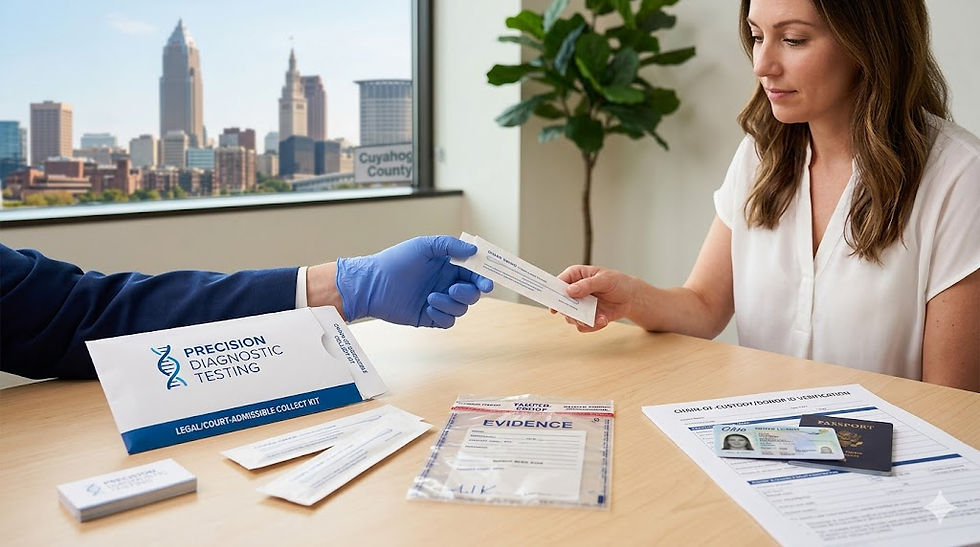
A legal DNA test, sometimes called a court-admissible or chain-of-custody test, requires:
• Collection at a vetted, independent site by a trained collector who has no relationship to either party.
• Photo identification of all donors at the time of collection.
• Specimen sealed in the donor's presence, with the donor initialing the seal.
• A complete chain-of-custody form documenting every handoff from collector to courier to laboratory.
• Processing at an AABB-accredited laboratory.
The rule is simple: if there is any chance you will need this result for a custody case, child support order, immigration petition, estate proceeding, or any other legal matter — get the legal version from the start. Upgrading from a non-legal to a legal test means starting the collection over entirely.
When DNA Results Are Needed for Immigration
U.S. Citizenship and Immigration Services (USCIS) and the National Visa Center accept DNA test results to establish biological family relationships when documentary evidence is unavailable or insufficient. These tests must be conducted through an AABB-accredited laboratory and follow a specific collection protocol that includes embassy or consular coordination in some cases.
If you are pursuing a DNA test for immigration purposes, it is worth confirming with your immigration attorney which specific requirements apply to your petition before scheduling collection. Precision Diagnostic Testing can coordinate these cases and will walk you through the requirements before you commit to testing.
How to Get Started
The simplest thing you can do is call us and describe your situation. We will ask a few questions — what relationship you are trying to establish, whether the result may be used in a legal proceeding, who is available to provide a sample — and we will recommend the right test before you pay anything.
We coordinate DNA testing throughout the Cleveland area and statewide in Ohio, with nationwide collection site access when a donor is out of state. Most appointments in the Cleveland area are available within 1 to 3 business days.
Conclusion
DNA testing is not complicated once you understand what each test is designed to do. The most common mistake is ordering the wrong type — usually a non-legal test when a court-admissible one was needed — or ordering a sibling test when a direct paternity test is still possible with some coordination.
Precision Diagnostic Testing exists to prevent that mistake. If you are not sure where to start, call our office in Cleveland or send a message through our website. The consultation is free, and we would rather take five minutes to point you in the right direction than have you spend money on the wrong test.
To schedule or to ask a question, contact Precision Diagnostic Testing in Cleveland, Ohio.
Comments